
Temple City Previous Resident Sources
A single address has several timelines. The recorder follows ownership and legal descriptions. Directories and census schedules provide occupant evidence at selected dates. City permits can show a project address and the people named on an application. Cemetery, obituary, and probate sources can close a trail after a move or death. The table shows the verified local coverage before a search begins.
| Source | Years It Covers | Where Held | What It Shows |
|---|---|---|---|
| Recorded instruments and index | 1850/1851-present | RR/CC Norwalk | Grantor, grantee, recording details, legal description, and title transfers. |
| Temple City directories | 1931-32, 1935, 1937, 1939, 1941, 1948, 1951, 1953, 1955, 1959 | ACPL discovery lead, subscription images, and institutional collections | Names, addresses, and sometimes occupation or household clues. |
| Federal census | 1930, 1940, and 1950 releases | NARA and partner databases | Household occupants at a census date, with enumeration-district context. |
| Temple City permit archive | Start date not located; surviving scans vary | City permit search and City Hall records | Project address, APN, owner, applicant, contractor, and work details when released. |
| San Gabriel Cemetery locator | Historical interments; mapped coverage is not complete | San Gabriel Cemetery | Burial location and interment clues for a former resident. |
| Decedent, obituary, and probate sources | Decedent registers from 2012 onward; older coverage varies | LA County, newspapers, cemetery, and Superior Court | Death, family, estate, and former-address leads. |
Start with the current parcel when the address is known. Start with a directory or census when the occupant and year are known but the deed is not. Each source answers a narrower question than the phrase “previous residents” suggests, so the strongest result is a dated chain of separate facts.
The county recorder’s real estate records overview establishes the offline deed route used for Temple City house histories. A visual reference to that official record channel appears below.
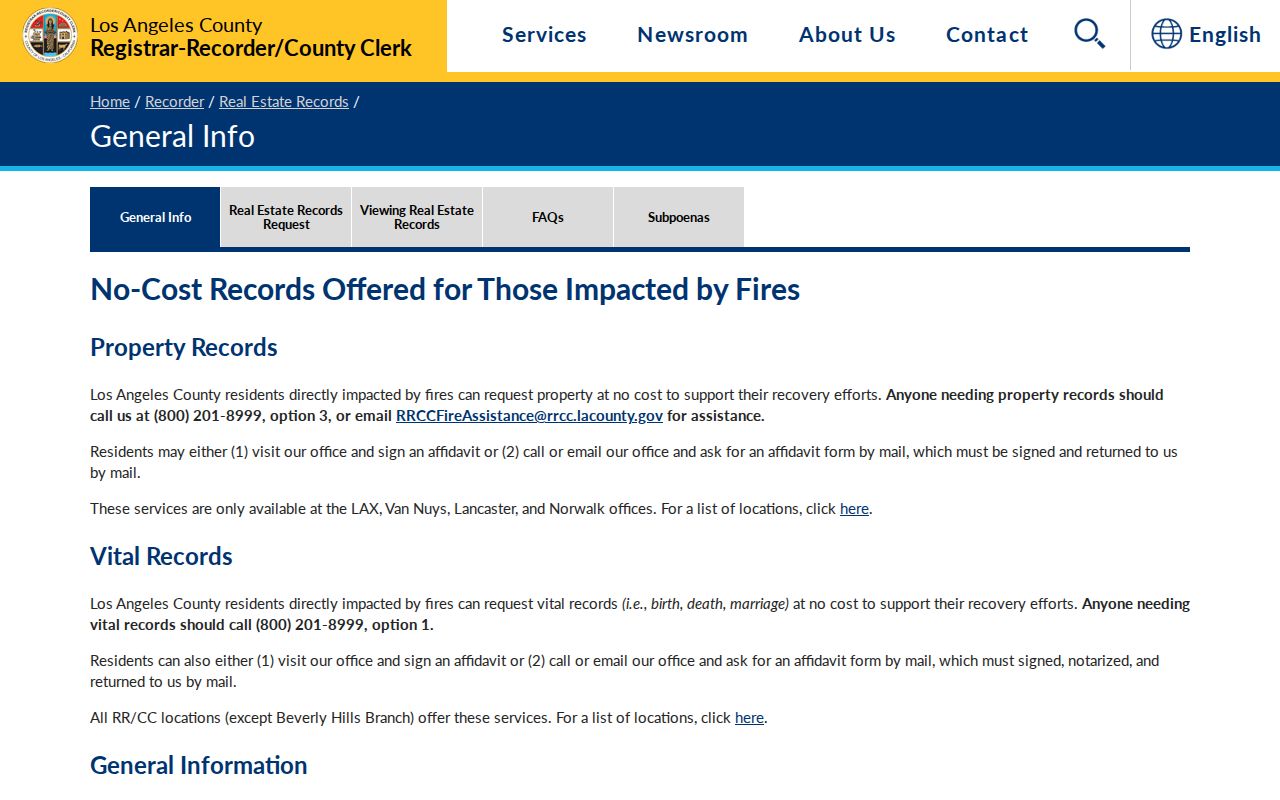
The recorder image reinforces the central split: an official records office holds the instruments, while the searcher must convert an address into a person and year before the index can be used.
Temple City Deed Trail for Past Owners
Los Angeles County real estate records reach back to 1850, but the public index is not on the Internet. At Norwalk, 1851-1957 material is on the lower level and 1958-present material is on the second floor. Entries are alphabetical by grantor and grantee name and recording year, not by street address or AIN. Staff do not accept index searches by phone, and appointments can be scheduled up to two weeks ahead.
- Confirm the current situs address and AIN in the Los Angeles County Assessor Portal. Obtain the current owner context at the Assessor counter when it is necessary for a lawful records search.
- Estimate the acquisition year and look for the current owner as a grantee in the Norwalk name-and-year index. Record the document number, instrument type, recording date, and grantor.
- Read the deed’s legal description and compare it with the parcel anchor. A legal description identifies the land more reliably than a street label alone.
- Search the grantor as an earlier grantee. Repeat the name-and-year chain backward, checking that each instrument refers to the same parcel.
- Order a copy after the document number is known, or supply names, recording year, and document title when the number is not available. Older work remains an onsite index task, not an online lookup.
- Grantor and grantee
- The grantor transfers an interest. The grantee receives it. Searching both sides lets a chain move backward.
- Chain of title
- A linked sequence of recorded transfers for one parcel, checked against legal descriptions.
- Legal description
- The recorded land description that supports parcel identity when an address, city label, or numbering convention changes.
- Index and image
- The index points to a record. The deed image or certified copy contains the instrument itself.
RR/CC lists a plain copy at $5 for the first page plus $3 for each additional page. A certified copy is $6 plus $3 for each additional page. A name-and-year search is $0.50 per name and year, with a $1 minimum. Mail goes to the Real Estate Records Section, P.O. Box 1130, Norwalk, CA 90651-1130; the office lists (800) 201-8999 option 3 and recorder@rrcc.lacounty.gov. A copy request is most efficient after the chain supplies a document number.
Temple City Current Parcel Anchor
The current Assessor parcel is the fixed point for a past-resident search. Its web search accepts a ten-digit AIN or exact situs address. The result can show the AIN, situs, use type, parcel status, assessment values, building and land characteristics, map links, exemption flags, and recent parcel-change activity. The recent-sales layer covers the last 24 months. These facts locate and describe the parcel, but they do not prove who lives there.
Online owner-name searching is not available. Owner identity and tax-mailing information are available at an Assessor district office or through Property Data Sales, not through the public web result. The East District Office is at 1190 Durfee Avenue, South El Monte, CA 91733, (626) 258-6001, with weekday hours of 8 a.m. to 5 p.m. A mailing address that differs from the situs can suggest a question for further research, but it cannot identify an occupant.
The AIN commonly appears as four map-book digits, three page digits, and three parcel digits, such as 1234-567-890. The parcel map is an assessment tool, not a survey. The web boundary description is not the deed’s legal description, and a city label on the result may not settle the incorporated or unincorporated jurisdiction.
Temple City Past Residents in Directories
Ownership and occupancy diverge. Temple City directory coverage is verified for 1931-32, 1935, 1937, 1939, 1941, 1948, 1951, 1953, 1955, and 1959, but the exact publisher for each year is not established. The years are a discovery lead, not proof that every edition is a Polk volume. The 1935 Los Angeles Extended Area white pages use a surname, given name or initials, an “r” for residence, a number and street, and a telephone exchange. The edition was revised July 8, 1935, so a September cover date should not be treated as the listing date.
Pair the newest available directory year with the nearest federal census, then work backward. Preserve initials, spouse notation, occupation, and the full address when shown. The 1930, 1940, and 1950 census releases can add household members at an enumeration date. When optical character recognition fails, search the enumeration-district map and description, then browse pages. The Los Angeles Public Library’s digitized city and street directories, covering 1875-1987 in multiple runs, can add address-searchable context.
- Write the exact address and the directory year beside every entry.
- Compare the directory address with the census enumeration district and household listing.
- Mark a disappearance as an open question. It may reflect a move, an unlisted phone, a publication gap, death, or a change in the printed run.
- Test the occupant clue against a deed, permit, obituary, or probate record before calling that person a former resident.
The Temple City city directory collections page carries the shelf and year details. Here, those collections function as the occupant bridge between the property chain and the people who may have lived at the address.
Temple City Permit Records for Old Addresses
Temple City’s permit search is address-keyed. Choose the street name first, then choose the street number to open scanned permit images. The legacy interface permits only one or a few concurrent users, so a “busy” result calls for a later retry. The current case search covers pending building permits, plan reviews, and active code-enforcement cases, which are useful for present context but do not replace the historic archive.
The paper building-permit application shows what an old file may contain: project address, city, ZIP, APN, cross street, project name and description; owner and applicant names and contact details; contractor identity and license information; and architect, engineer, or designer details. Those are application fields, not a promise that each field survives or is released without redaction. Single-family residential building plans are retained for only six months, while industrial, commercial, and multifamily plans are retained for the structure’s life.
Permit names help date construction or a major alteration. They do not, without other evidence, establish that an applicant owned the parcel or occupied it. The archive’s coverage start date was not exposed in the reviewed official sources. That gap should remain visible rather than being filled with an invented date.
Temple City Past Residents Before 1926
Temple City was unincorporated before incorporation in 1960, and the town was called Temple until 1926. Searchers looking for previous residents should test “Temple,” “Temple City,” Alhambra, San Gabriel, and Los Angeles County, then compare the address and enumeration district. County Board minute books begin in 1852, while digitized Board records reach 1873, so the resident trail predates the city government.
Walter P. Temple founded the Town of Temple in 1923 on about 300 acres of former Rancho Santa Anita. Townsite streets used names tied to the Temple family and associates, including Workman, Kauffman, Rowland, Temple, and Agnes. The Pacific Electric station at Las Tunas and Kauffman opened in 1924. Those names and the former rail setting can help explain why an older directory, map, or deed uses a label that does not match a modern city search.
No official street-renumbering table was located. A modern address should therefore be treated as a hypothesis when it is carried backward, not as a guaranteed historical key.
Temple City One-Sheet Sanborn Limit
The Library of Congress item titled “Sanborn Fire Insurance Map from Temple, Los Angeles County, California” is dated May 1925 and is exactly one sheet. It is filed under Temple, one year before the name became Temple City. A Sanborn sheet can show building footprint, use, construction notes, and fire-protection context, but this sheet covers only a small town core.
Use the Library of Congress Sanborn record as a local map lead. The reviewed research did not verify a later Temple City-specific Sanborn run or a complete local sheet series. Absence from the 1925 sheet does not show that a house did not exist. It may simply have stood outside the mapped core.
Research gap. No verified Temple City street-renumbering table, later Sanborn run, or permit-archive start date was found. Keep those questions open when a house history reaches beyond the one 1925 sheet.
Temple City Previous Residents and Obituary Trails
Death records can connect a former address to a family, cemetery, or estate, but they should be treated as trail endpoints rather than automatic address proof. The LA County Office of Decedent Affairs publishes annual cremation registers from 2012 onward. Older deaths may surface in newspapers, cemetery records, funeral notices, probate files, or the Los Angeles Times Historical Archives. The Superior Court probate channel can then add petitions, heirs, and estate documents when the case is public.
The LA County decedent-records resource is shown below for the current register route.
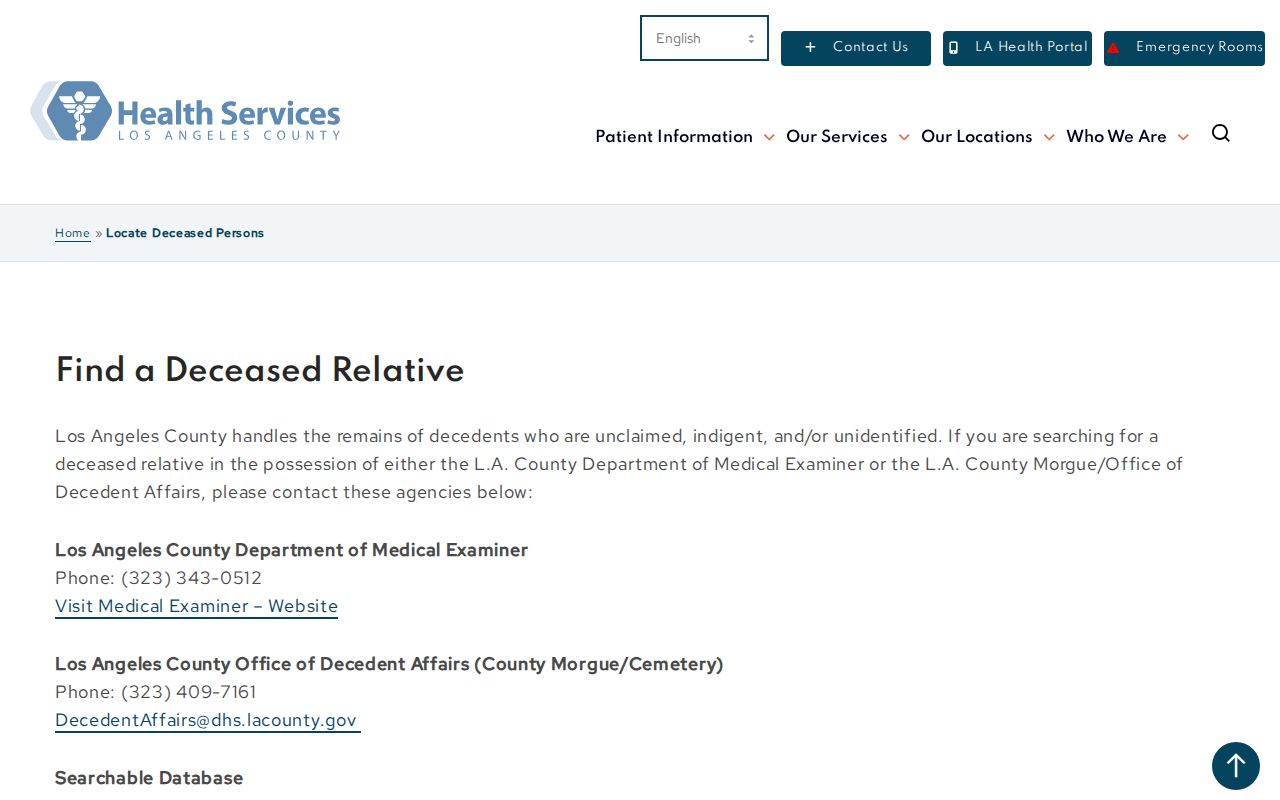
The decedent resource is most useful when a name and approximate date already come from a directory, obituary, or family record. It is not a substitute for an address-linked source.
San Gabriel Cemetery reports that about 98 percent of interments are mapped and that the locator is updated weekly. If a name is absent, call Monday through Friday from 8 a.m. to 4 p.m. The San Gabriel Cemetery search is shown below as the cemetery check.
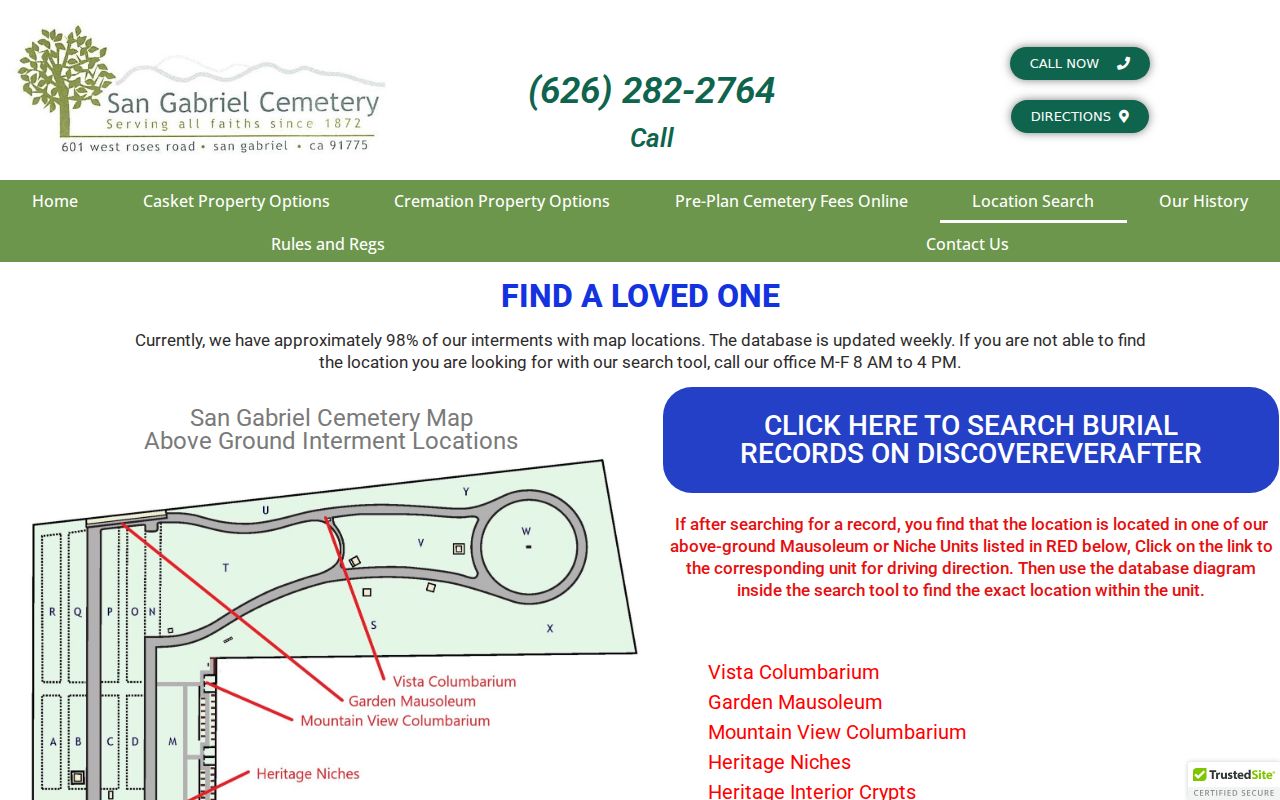
A cemetery result can confirm an interment place and dates, then point toward an obituary or estate file. It does not alone show that the person lived at a particular Temple City address.
No official Temple City-specific obituary index, municipal cemetery database, or complete public local death index was located. Those are documented gaps, not invitations to infer a match from a similar name.
Temple City Library Address Trail
Temple City’s library history offers a useful Profile 4 house-history story because the institution itself moved through several addresses. Willa Samson began a home lending library. In 1924, her cottage at 9961 Woodruff became the first official branch. The library later used the abandoned Pacific Electric building at Las Tunas and Kauffman, the Woman’s Clubhouse west wing in 1941, a county building on Kauffman in 1953, and the current branch at 5939 Golden West Avenue in 1963.
Each location can be tested with the same tools used for previous residents: an Assessor parcel, recorder instruments, directories, permits, city archive material, and newspaper coverage. The address sequence is not a resident list, but it shows how civic history can preserve a chain of places even when a complete reverse directory is missing.
The El Campo Santo site at Workman and Temple Homestead Museum connects the founder family to a cemetery established in the 1850s and a Temple mausoleum from 1921. There is no verified municipal Temple City cemetery or public Temple City interment database in the reviewed sources. The El Campo Santo and Temple family-history resource appears below.
That regional cemetery connection can help place an early Temple family reference without pretending it is a city-owned record. For any living person, keep the work to lawful house history, genealogy, and personal curiosity. Do not use a past-resident trail to monitor, intimidate, or harass someone.