
Temple City Directory Years
The located Temple City directory leads are intermittent, not a proven annual run. The dates below are useful targets for a library or database search. They should be treated as located leads until a repository confirms the volume, title page, and access terms.
| Collection | Years or run | Where held | Access |
|---|---|---|---|
| Temple City locality leads, publisher not located | 1931–32, 1935 | Allen County Public Library Genealogy Center discovery inventory | Use the locality lead; confirm the physical or image copy with ACPL. |
| “U.S. City Directories” images | 1937, 1939, 1941, 1948, 1951, 1953, 1955, 1959 | Ancestry and institutional access | Subscription or library access may be required; title-page publishers were not inspected. |
| Digitized commercial collection | 1941, 1951, 1955, 1959 | MyHeritage | Account access is likely required; verify the image and volume label. |
| “Polk’s Temple City” catalog entry | Exact volumes not exposed | FamilySearch catalog | Sign-in or affiliate rights may apply; do not infer that every located year is Polk. |
| Los Angeles city and street directories | 1875–1987 | Los Angeles Public Library Visual Collections | Free digitized access with name or address search. |
| Los Angeles Extended Area white pages | September 1935; related 1941 and 1945–46 records | Library of Congress | Free images and OCR; the locality index names Temple City. |
| Californiana directories and histories | From the nineteenth century; Temple titles not enumerated online | Norwalk Library closed stacks | Ask staff to confirm a title before travel. |
These rows do not establish a continuous 1931–1959 series, a last printed year, or an exact local reverse-directory run. Missing years may reflect publication gaps, catalog limits, or an uninspected shelf. Keep “located lead” and “verified volume” as separate labels in a research log.
The FamilySearch Los Angeles County catalog is the route for checking the “Polk’s Temple City” title lead and related holdings.
The catalog image supports careful source labeling. Record the exact title, place wording, year, repository, and viewing rights when a volume is opened.
Temple City Directory Publishers
Publisher certainty is uneven. The research located a FamilySearch catalog title using “Polk’s Temple City,” but it did not expose exact volumes. The 1931–32 and 1935 leads are attributed to an Allen County Public Library discovery inventory, while later “U.S. City Directories” images were not inspected at their title pages.
That distinction matters. A directory can be indexed under a locality, digitized in a commercial collection, or described by a catalog record without proving who printed it. Do not label every Temple City edition Polk. Preserve the repository description until the title page, imprint, and edition year are visible.
A good citation names the collection, year, page or image, repository, and the exact locality heading. If access is through Ancestry or MyHeritage, note that the image may require an account or an institutional license. If a lead points to FamilySearch, sign-in or affiliate rights may limit what can be seen.
Reading a Temple City Directory Entry
The 1935 Los Angeles Extended Area white pages show the kind of evidence a historical address book can carry. The volume is white pages only. A typical line begins with a surname and given name or initial, marks a residence with “r,” gives a house number and abbreviated street, and ends with an alphabetic exchange and telephone number. A business line may use a firm name and business address.
| Subscriber name | Surname followed by given name or initials. |
|---|---|
| Residence mark | The letter “r” signals a residence listing. |
| Address | House number and abbreviated street; locality may be inferred from the section or exchange. |
| Telephone | Alphabetic exchange followed by the number. |
| Business line | Firm name and business address when the line is not a residence listing. |
| Not consistent | Spouse, household members, ownership or occupancy marks, and other personal details are not shown on every line. |
The locality index explicitly includes Temple City, but OCR did not isolate a page positively to the city. Navigate from the locality or exchange index before treating a sample entry as local. The 1935 edition was revised to July 8 even though the cover is described as September. That July revision is a key trap: it is evidence of the revision state, not automatic proof that every line reflects the cover month.
- Criss-cross directory
- The street-order portion of a volume, read by address rather than surname. Verified Temple City year runs were not published in the sources inspected.
- Householder index
- An index organized around the person treated as the address's main listing. It may not include every person in a household.
- Abbreviation key
- The volume's guide to short forms such as residence marks and street terms. Read it before expanding a line.
Temple City Directory Access
Repository access differs by collection. Allen County Public Library is a discovery and genealogy route for the early locality leads. Ancestry exposes “U.S. City Directories” images through subscription or institutional access. MyHeritage has a smaller set of digitized Temple City years and likely requires an account. FamilySearch supplies a catalog lead, with sign-in or affiliate rights possible.
The Los Angeles Public Library is different: its digitized city and street directories cover 1875–1987 and are available free through the Visual Collections search. The Library of Congress provides free images and OCR for the 1935 Extended Area telephone directory. LA County Library's local-history and Californiana routes are staff-led and closed-stack rather than a simple public name index.
Use the LA County Library local-history collection for broader California directories, newspapers, census schedules, and official histories. For a Temple City-specific title, ask for confirmation rather than assuming that a general Californiana listing includes the year needed.
The LA County Library local-history collection is the wider shelf behind Temple City volume research.
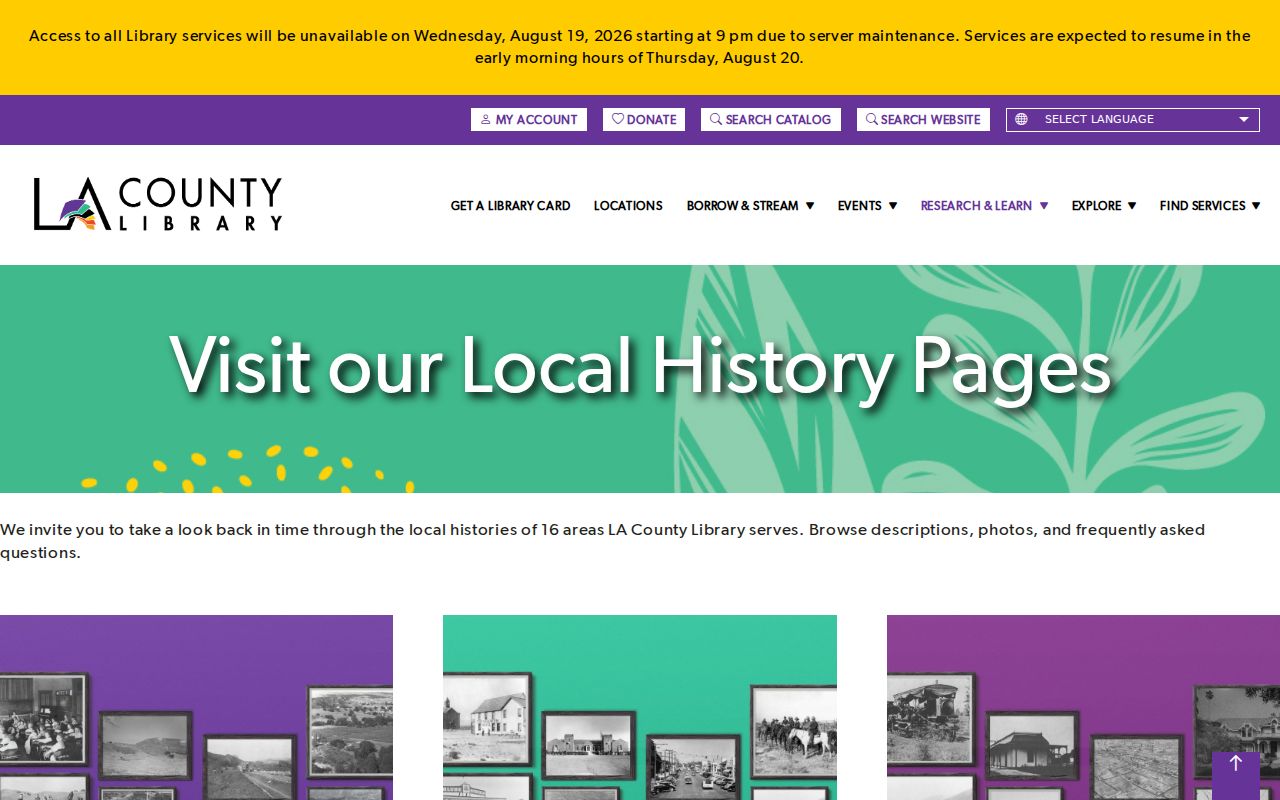
The library image points to a staffed research channel. A closed-stack request can be more useful than an unverified online year list.
Search Temple City in LAPL Directories
The LAPL digitized city and street directories collection is a valuable companion because it supports searching by name or address across Los Angeles-area material from 1875–1987. It is not a claim that every Temple City edition is present. Use the locality, street, and address terms shown in the scan, then inspect the page image instead of trusting OCR alone.
An address hit can bridge a gap between a named Temple City volume and a broader regional run. Keep the directory title and locality heading together. A line indexed under Los Angeles may still concern a San Gabriel Valley address, while a Temple City label may reflect the naming practice of that edition.
The Library of Congress 1935 Extended Area item supplies a second free route with images and OCR. Use it for a telephone-subscriber clue, not as a verified local reverse directory. The research did not establish exact local criss-cross holdings in any year.
The Los Angeles Public Library directory collection supports name and address searching across a long regional span.
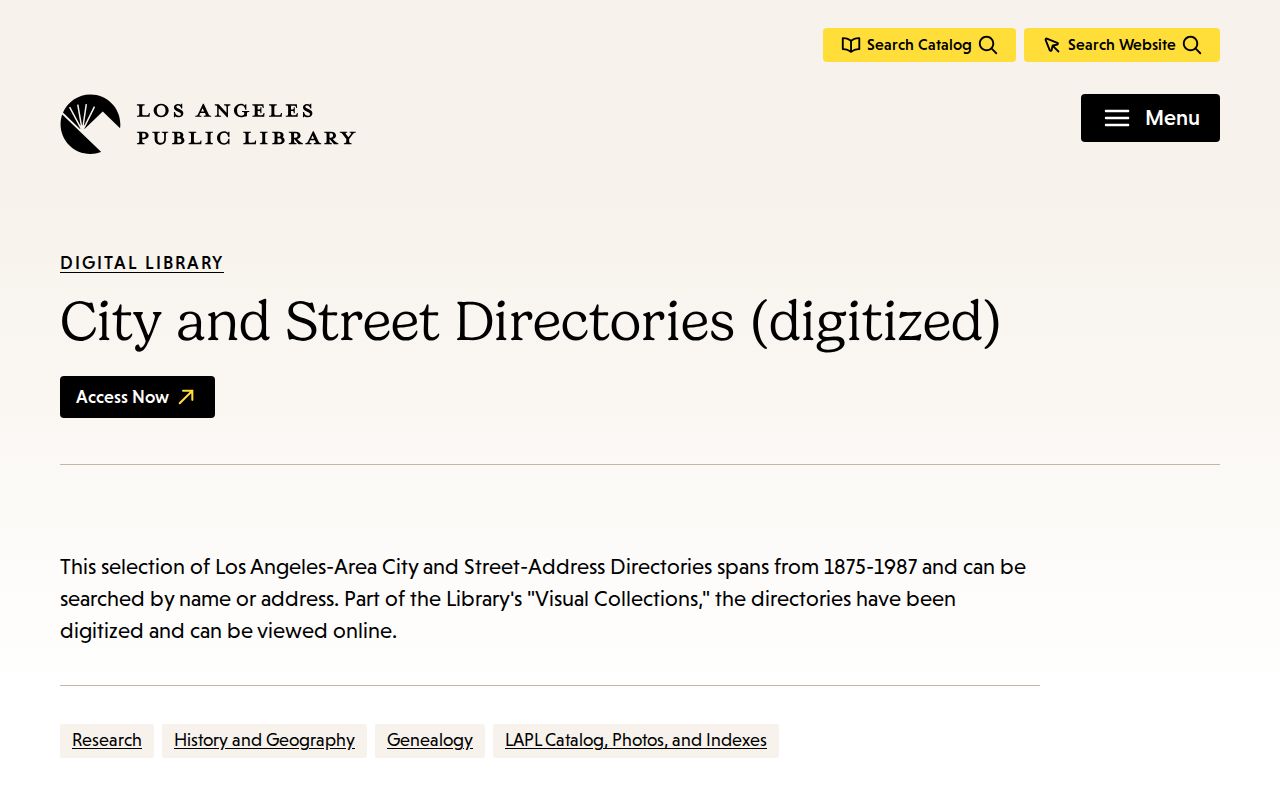
When OCR and the page disagree, cite the page image and preserve the original spelling. That is especially important for abbreviated streets and older place names.
Temple Before the Modern Directory
Before 1926, the town was called Temple. Walter P. Temple's 1923 townsite and the later city name describe different administrative moments. A pre-1926 map or catalog entry may therefore use Temple even when a modern researcher would write Temple City.
Search “Temple,” “Temple City,” Alhambra, San Gabriel, and Los Angeles County when a person or address vanishes from a modern locality search. Preserve the catalog wording, recording jurisdiction, title, and date as separate facts. Do not silently modernize the place name in a citation.
The town was unincorporated before the 1960 incorporation, so county agencies, the Chamber, library, railroad, school, and civic-club records matter for earlier residents. The historical trail does not begin with city government.
- 1923: Walter P. Temple's townsite begins on former Rancho Santa Anita land.
- 1924: the Pacific Electric station and the first official library branch create new address and directory anchors.
- 1926: the town name changes from Temple to Temple City.
- 1931–32: the earliest located Temple City directory leads in the research set appear.
- 1960: Temple City incorporates, after the earlier county-era record trail.
Pair Temple City City Directories with Census
A directory gives a year or revision state. A federal census gives a household snapshot at a census date. Pair the located directory years with the 1930, 1940, and 1950 census rather than treating either source as a full annual roll. The 1950 Census search supports state, county or city, name, reservation, and enumeration-district paths.
- Start with the newest located directory lead, preserving the exact name, initials, address, and any residence mark.
- Search the next earlier lead and note whether the address, spelling, or locality label changes.
- Use the matching census decade to compare household members and an enumeration district, not just a name.
- When OCR fails, browse the enumeration-district map or description and inspect the page images.
- Close a gap with a deed, permit, obituary, cemetery locator, or library source, keeping each date distinct.
The 1950 image and the directory line answer different questions. A census can show a household at one enumeration point, while a directory can show a subscriber or address between census years.
The National Archives 1950 Census portal provides a federal comparison point for Temple City entries.
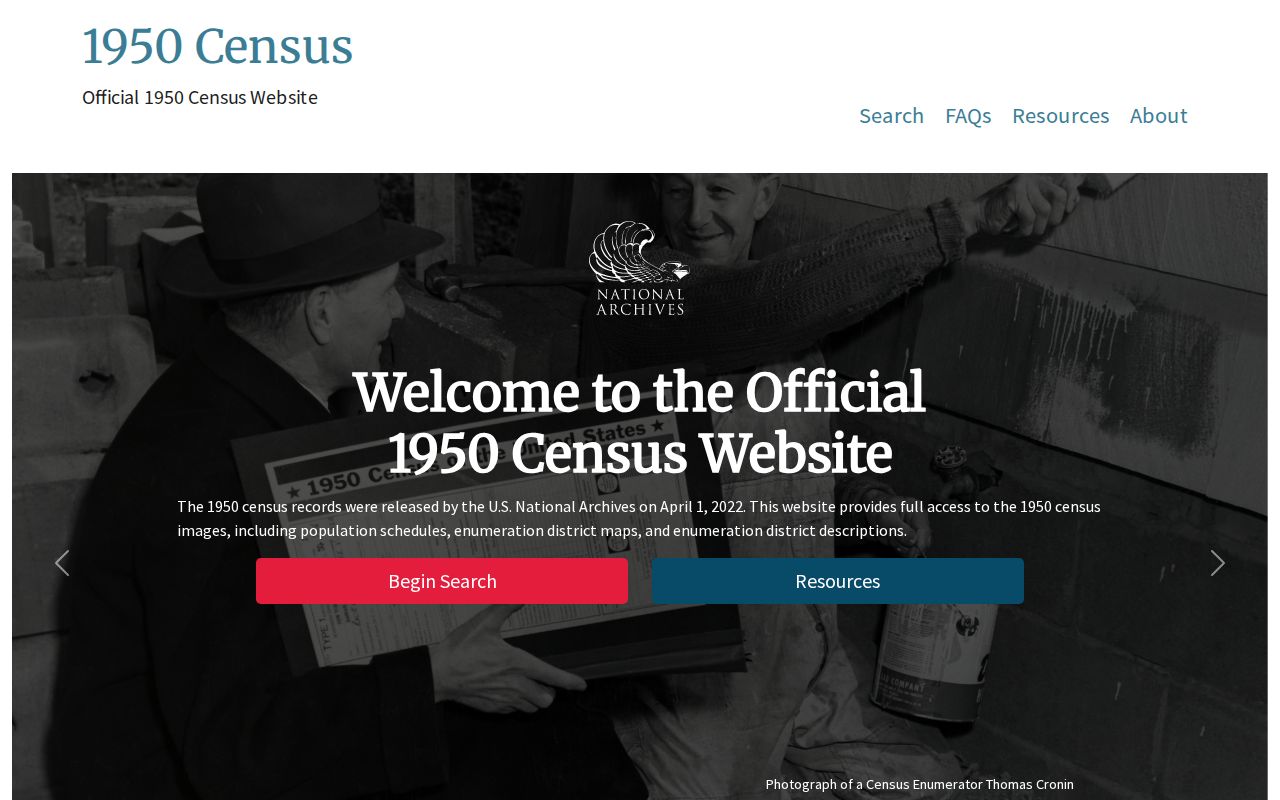
Use the census image as a check on time and household context, not as a substitute for the directory page or a current custodian.
Temple City Directory and the One-Sheet Sanborn
The May 1925 Library of Congress Sanborn item is filed as “Temple,” not Temple City, and it is exactly one sheet. It can show a small town-core footprint, building use, and fire-insurance map context, but it does not cover every modern street or prove that an absent address had no structure.
Use the 1925 Temple Sanborn map record beside a directory or deed when the address is in the mapped area. A missing line may mean the place fell outside the one-sheet footprint. The map is a historical limit, not a complete local directory.
This is a useful profile quirk: the strongest local map lead predates the 1926 name change and the 1960 incorporation. Search the source as cataloged, then connect the older label to later address evidence.
Norwalk Californiana for Temple City Directories
LA County Library's Californiana collection includes more than 24,000 books, over 200 newspaper and magazine titles, California census schedules from 1850–1910, official histories, and nineteenth-century directories. Temple City titles are not enumerated online, so the practical route is a staff question before travel.
Norwalk Library is at 12350 Imperial Highway. The research gives (562) 868-4003 and referenceservices@library.lacounty.gov for confirmation. Ask for the exact title, year, format, closed-stack procedure, and whether a staff member can check a locality heading or a related Los Angeles-area volume.
The Historical Society of Temple City museum at 5954 Kauffman Avenue is another appointment-based context source for photographs, club ephemera, programs, and family material, but it publishes no searchable directory catalog. Treat those materials as leads that need corroboration.
Temple City Library Address Trail
Temple City's own library history is a small address story that shows why buildings and directories belong together. Willa Samson began a home lending library. In 1924, her cottage at 9961 Woodruff became the first official branch. The branch then moved to the abandoned Pacific Electric building at Las Tunas and Kauffman, the Woman's Clubhouse west wing in 1941, a county building on Kauffman in 1953, and the present 5939 Golden West Avenue location in 1963.
Those five addresses can be checked through deeds, permits, maps, directories, and civic ephemera. They do not prove that every library user or staff member lived nearby. They show how a local institution leaves an address trail even when a complete resident directory is missing.
The “Home of the Camellias” tradition offers another human link. Festival programs and photographs can reconnect classmates and civic participants, especially when a directory name needs context. Use the programs as a lead, then corroborate a person or date with the library, school, newspaper, or county record that holds the underlying item.
Trace a Temple City Directory Household
Household tracing works best when each volume is treated as a dated observation. Start with the newest located lead, then move backward through 1959, 1955, 1953, 1951, 1948, 1941, 1939, 1937, 1935, and 1931–32 as available. Do not fill the gaps with an assumed continuous run.
- Copy the exact name, initials, address, residence mark, exchange, and locality wording from the newest available entry.
- Search the next older volume and preserve spelling changes, a new house number, a spouse mark, or a disappearance.
- Flip to an address-ordered section only when the repository confirms that a criss-cross section exists for that volume.
- Pair the directory date with the 1930, 1940, or 1950 census and compare the enumeration district or household context.
- Use LAPL address search, a deed, a permit, an obituary archive, or a cemetery locator to test a gap.
Disappearance can mean a move, a death, an unlisted telephone, a publication gap, or a change in locality labeling. It does not establish one cause. A historical directory clue becomes stronger when a second source supplies a separate date and record purpose.